
Old Panel or Old Wiring? What Should You Fix First in the Coachella Valley
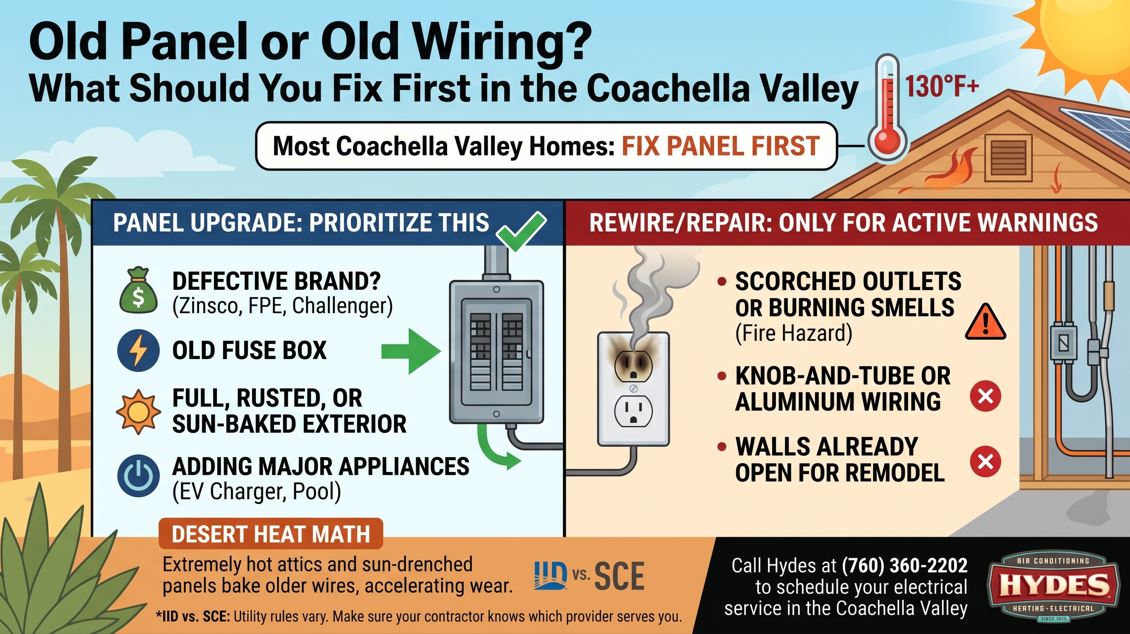
The short answer: Fix the panel first in most Coachella Valley homes. Not because panels matter more than wiring, but because the panel is the only place in your house where you can install protection for wire you can't see and can't yet afford to replace.
A modern panel reduces the fire risk of aging branch wiring immediately, and it tells you which circuits are actually failing. Fix the wiring first only when the wiring is already failing in ways no breaker can stop: warm outlets, scorched devices, a burning smell, or energized knob-and-tube.
You should only prioritize rewiring over a panel upgrade if you are experiencing active, visible warning signs inside your living space.
When to Upgrade the Panel First
-
You have a Zinsco, Federal Pacific (FPE), Challenger, or Pushmatic panel: These specific brands have well-documented design defects where breakers fail to trip during a fault or physically melt to the panel bus bar.
-
You have an old fuse box: Fuses cannot accept modern arc-fault or ground-fault protective breakers.
-
Your panel is full, rusted, or sun-baked: Exterior panels mounted on west-facing walls take a beating in the desert sun, causing internal connections to corrode.
-
You plan to add major appliances: If an EV charger, pool heater, heat pump, or casita is in your two-year plan, you will need the extra panel capacity anyway.
When to Fix the Wiring First
-
Hot, discolored, or scorched outlets: Heat at an outlet means a loose, dangerous wire connection inside the wall box. Standard breakers will not trip for this type of failure.
-
Burning plastic or fishy smells near outlets: Turn off power to that circuit immediately and call an electrician.
-
Knob-and-tube or aluminum branch wiring: Knob-and-tube wiring lacks a ground wire and overheats when covered by modern attic insulation. Aluminum wiring (common from 1965–1973) requires specialized, listed connectors at every outlet to prevent loose, high-resistance connections.
-
Your walls are already open for a remodel: Opening walls accounts for most of a rewiring bill. If you are already renovating, take advantage of the open drywall.
Why Desert Heat Changes the Math
Generic electrical advice online fails to account for life in the Coachella Valley:
-
Extreme Attic Temperatures: Desert attics routinely exceed 130°F in the summer. Sustained heat bakes older wire insulation until it becomes brittle, severely reducing how much power older wiring can safely handle without overheating.
-
Rooftop & Sun Exposure: Sun-drenched exterior panels and rooftop A/C wiring operate much hotter than equipment in coastal cities, causing thermal breakers to trip under heavy summer loads.
-
Local Housing History: During the valley’s massive building boom from the 1950s through the 1970s, Zinsco panels were installed heavily across Palm Springs, Cathedral City, Indio, and La Quinta.
Local Detail: IID vs. Southern California Edison
The valley is split between two power utilities.
- Imperial Irrigation District (IID) serves eastern communities like Indio, La Quinta, and Coachella.
- Southern California Edison (SCE) serves Palm Springs, Desert Hot Springs, and Cathedral City (with Palm Desert split near Washington Street).
Each utility follows its own equipment, meter location, and permitting rules for panel upgrades. Make sure your electrical contractor knows which side of the utility line your home sits on before work begins.
Quick Decision Guide
Determine your next step based on your home's current electrical situation.
| Your Current Situation | Recommended First Step | Why? |
|---|---|---|
| Defective panel brand (Zinsco, FPE) | Replace Panel | Design defect; breakers may fail to trip during an overload. |
| Scorched outlets or burning smells | Fix Wiring First | Active fire hazard; panel breakers cannot detect loose outlet screws. |
| Old wiring, but no active symptoms | Replace Panel | Modern AFCI breakers add immediate protection to existing wires. |
| Adding an EV charger, pool, or solar | Replace Panel | Capacity issue; upgrade the panel once to support new loads. |
| Renovating with drywall removed | Rewire | Wall access is the largest labor cost in rewiring. |
Estimated Project Cost
| Service | Typical Cost Range |
|---|---|
| Standard Panel Replacement | $2,000 – $4,500 |
| 200-Amp Service Upgrade | $3,500 – $7,000+ |
| Partial Wiring Repairs | $1,500 – $8,000 |
| Whole-Home Rewire | $8 – $15+ per sq. ft. |
Frequeantly Asked Questions
Does a new panel make old wiring safe?
No and any contractor who says otherwise is overselling. A new panel with arc-fault breakers substantially reduces the fire risk from arcing faults in deteriorated wiring, which is the most common ignition mechanism. It does nothing about a loose, overheating connection inside a wall box, and it doesn't add a ground where none exists. It's meaningful risk reduction, not a substitute for rewiring.
My panel is 30 years old but works fine. Do I need to replace it?
Not necessarily. Age alone is a weak indicator. What matters is the brand and bus design, the condition of terminations, whether it's full, whether it can accept modern protective breakers, and its thermal environment. A sound 1990s panel in a shaded location may have years of service left. Have it identified before you accept a replacement recommendation based only on its age.
Why do my breakers trip more in summer?
Partly load because AC, pool equipment, and pumps all run harder.
But partly physics: thermal-magnetic breakers trip based on heat, and a panel in a sun-exposed location is already warm before any current flows. Combined with conductors derated by high ambient temperature, summer tripping in a desert home often reflects a circuit operating much closer to its real limit than its breaker rating suggests.
What's a bootleg ground, and why does it matter?
It's a jumper installed between the neutral and ground terminals of a receptacle to make an ungrounded two-wire circuit accept a three-prong plug and pass a basic outlet tester. It creates a false sense of safety and can energize the equipment ground under certain fault conditions. It's common in homes where three-prong outlets were retrofitted onto original two-wire wiring, and it's one of the first things worth checking in any home built before grounding was standard.
Do I need to rewire my whole house?
Usually not. Most older homes need targeted rewiring of specific circuits, not a whole-home gut. The difficulty is knowing which circuits — which is exactly what a panel replacement with arc-fault protection tells you, by revealing which circuits actually have arcing.
Should I do this before or after solar?
Before. Panel capacity, busbar rating, and main breaker size all constrain what a solar or battery system can interconnect. Discovering the panel needs replacing partway through a solar project is expensive and delays interconnection with your utility.
Navigating Coachella Valley's Unique Electrical Challenges
In most Coachella Valley homes, the panel goes first because it's the only place you can install protection for wiring you can't reach, because a large share of valley panels are from an era and a manufacturer with documented problems, and because the panel's protective devices will tell you which circuits deserve your rewiring budget.
The exceptions are clear. Active heat, scorching, or burning smells mean the wiring goes first, today. Knob-and-tube and aluminum branch circuits are wiring problems that no panel corrects. And if your walls are open for any other reason, that's your moment.
What doesn't work is guessing.
In a valley where attic temperatures routinely exceed the point at which pre-1984 cable has any listed ampacity at all, where the housing stock lines up almost exactly with a defective panel manufacturer's peak production years, and where thousands of homes have no attic to rewire through, the national advice simply doesn't fit.
Ready to evaluate your home's electrical system?
Call Hydes at (760) 360-2202 to schedule your electrial service in the Coachella Valley or you can contact us online with any questions.